
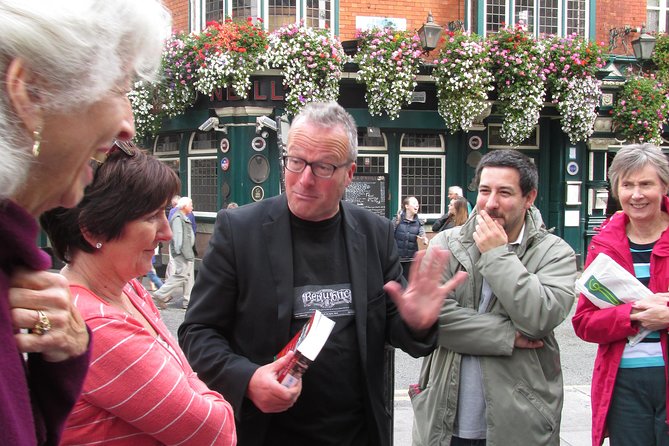
Reviewed · WALKING TOURS
1916 Rebellion Walking Tour
Some streets in Dublin feel louder than others. This 1916 Rebellion Walking Tour strings together the places where Easter Week unfolded, with stops you can see up close and stories that connect the dots from the Great Famine to 1916.
I especially love how the tour starts with context, not just dates. At the International Bar, you get a quick setup to the revolutionary period and plenty of time to ask questions before you hit the pavement. I also like the way you walk past major power centers like Dublin Castle and end at the GPO, so you understand what changed and why it mattered.
One possible drawback: the walk is listed at about 2 hours, but if your guide is in storytelling mode and the group asks a lot of questions, plan for it to run closer to 3 hours. With a max group size of 30, it can also feel tight at a few stops, especially near curbside landmarks.
In This Review
- What You’ll Get From a 1916 Rebellion Walking Tour in Dublin
- Entering Easter Week at 23 Wicklow St, International Bar Style
- The Famine-to-1916 Setup: Why the First 15 Minutes Matter
- City Hall During the Rising: Power Occupied, Power Reframed
- Dublin Castle: The British Administration in Plain Sight
- Four Courts From the Bridge: History Without the Stair Climb
- O’Connell Monument and the Chilling Detail: Bullet Holes You Can See
- Jim Larkin Statue: The Working-Class Voice Behind the Movement
- The GPO and PH Pearse: The Most Important Stop in Dublin
- Moore Street: Where the GPO Garrison’s Last Stand Happens
- The Bank of Ireland and the Old Parliament Idea
- Group Size, Timing, and What to Expect From the Walk Itself
- Why This Tour Is Such Strong Value for Dublin
- Who Should Book This, and Who Might Want Another Option
- Should You Book the 1916 Rebellion Walking Tour?
- FAQ
- How long is the 1916 Rebellion Walking Tour?
- What is the price per person?
- Where does the tour start?
- Is the tour in English?
- Is a mobile ticket provided?
- Are alcoholic drinks included?
- What places do we visit?
- Do I need prior knowledge about Irish history?
- What if the weather is poor?
- Can I get a full refund if I cancel?
What You’ll Get From a 1916 Rebellion Walking Tour in Dublin

You’ll learn the storyline, not just the sights. You start with the social and political buildup to 1916, so the landmarks make emotional sense.
Close-up viewing at key locations. You stop at major sites tied to Easter Week, plus nearby streets where events unfolded.
A guide-led conversation style. This is built for questions, not silent museum browsing.
Real visual reminders. Some stops include details like bullet holes you can still see.
Optional pub energy, with drinks on your terms. The meeting spot is a working pub, and alcoholic drinks are available for purchase.
Small enough to feel personal, big enough to meet people. Up to 30 travelers keeps it lively.
Entering Easter Week at 23 Wicklow St, International Bar Style

The tour begins at 23 Wicklow St near the famous International Bar. It is an easy meeting point to find, and the location is part of the experience, not just a starting dot on a map.
I like that you can arrive a little early. You can grab a pint (or skip it), and you will find introductory literature provided by the guide, which helps you get oriented before the first talk begins. It is a smart approach, especially if you come in with basic knowledge only.
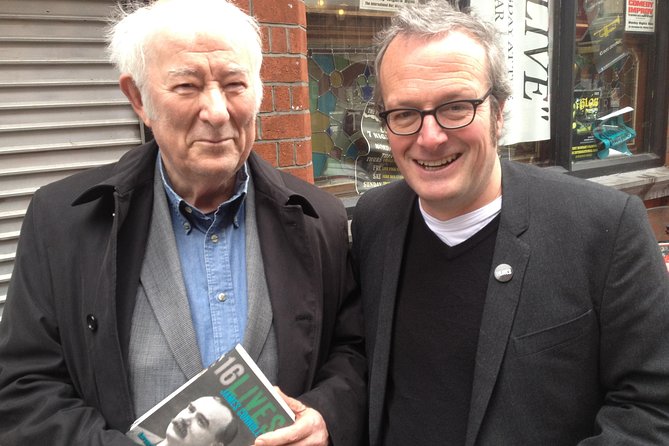
Guides are often the main reason people return, and one name shows up again and again: Lorcan Collins has been running the 1916 tour since 1996. Even if your guide is someone else that day, the structure and spirit feel consistent, with clear narration and storytelling that keeps moving.
The Famine-to-1916 Setup: Why the First 15 Minutes Matter
Your first stop is the International Bar, and the guide lays down the storyline from the 1840s Great Hunger and Irish Famine through the revolutionary period that leads to the 1916 Rising. This opening matters because 1916 did not happen in a vacuum. People were responding to decades of hardship, politics, and pressure.
This is also where you get into the rhythm of the tour. You will hear a short introduction, you will get the route preview, and you will be able to ask questions right away. That early Q and A is valuable, because it helps you catch up on names, factions, and the idea of Easter Week beyond a headline.
Time here is about 15 minutes, and the pacing is designed so you do not spend your whole walk at one stop. Still, it feels like you are being handed the keys to understanding what you are about to see.
More Guided Walking Tours in Dublin

City Hall During the Rising: Power Occupied, Power Reframed
Next up is City Hall, where the Irish Citizen Army occupied the building during the 1916 Rising. You do not just get a photo stop here. The guide connects this occupation to the bigger message of Easter Week, including who was taking control and why.
This stop is around 15 minutes, so it stays focused. You can expect the explanation to sit in the middle of the walk’s larger narrative: how revolutionary energy turned specific buildings and symbols into political statements.
A small practical tip: look around the streets before you start listening. Even without climbing anything, you can get a better sense of location once you notice the approach roads and sightlines.
Dublin Castle: The British Administration in Plain Sight
Then you move on to Dublin Castle, which served as the British administration base that controlled Ireland. If you have seen the Michael Collins movie, this is likely the kind of place you recognize in spirit, even if your real view is street-level.
At this stop, the guide explains Dublin Castle’s role during the 1916 Rising and the War of Independence. That sequencing is helpful. It shows how events were linked, rather than treating 1916 as a sealed chapter.
Time is about 15 minutes. The drawback is that the walk is crowded enough that you may not linger for long views in every direction. If you want photos, step aside briefly when the group is listening, then return to the guide’s spot when it is time to move.
More Irish streets taken slow:
- 2-Hour Historical Walking Tour from Dublin
★ 5.0 · 875 reviews - Historical 2-Hour Guided Walking Tour of Dublin
★ 4.7 · 865 reviews - Dublin Traditional Irish 3 Course Meal Walking Tour with Local
★ 5.0 · 755 reviews - Dublin: Mythology, Folklore and Legends Walking Tour
★ 4.9 · 703 reviews
Four Courts From the Bridge: History Without the Stair Climb
One of the smartest choices on this tour is how it handles Four Courts. The building itself is best seen from a bridge over the River Liffey, rather than trying to crowd around the structure up close.
You learn that Four Courts was occupied by revolutionaries in 1916, and again during the build-up to the Irish Civil War in 1922. The guide then explains the role it played, plus the intricacies of the civil war. Seeing it from the river makes it easier to grasp the geography and why control of certain spaces became such a big deal.
This is another roughly 15-minute stop. If the weather is good and you can listen while standing near the river, it feels especially real. You get a sense of how the city layout shaped movement, not just how people talked about it.
O’Connell Monument and the Chilling Detail: Bullet Holes You Can See
At O’Connell’s Monument, the tour slows down for one of the more haunting details. You will stop to look at bullet holes still visible from the Rising, and the guide explains the positions occupied by the British and the Irish in 1916.
That moment is exactly why this kind of walking tour can hit harder than reading a timeline. You are looking at a scar in stone that time did not erase. It turns the story from abstract into something physical.
Expect about 15 minutes here, plus little side stops along the route. The route is flexible, so you may see slightly different street corners depending on the day. That said, the emotional weight of this stop stays consistent.
Jim Larkin Statue: The Working-Class Voice Behind the Movement
Next you will reach the Jim Larkin Statue. Big Jim Larkin was a union man from Liverpool, and the guide connects him directly to James Connolly and to the Dublin working class.
This section helps you understand that the Rising was not only a top-down political event. People were mobilizing through labor and community networks, which changes how you read the week of action.
The stop is around 15 minutes. It is a good pace break before you head back into the city’s most symbol-heavy sites.
The GPO and PH Pearse: The Most Important Stop in Dublin
Now we get to An Post General Post Office (GPO). This is the HQ for the revolutionaries in Dublin, and it is one of the tour’s headline moments. The GPO is also tied to national memory because PH Pearse read the Proclamation here.
Time at the GPO is about 30 minutes, and it usually feels like the heart of the tour. You get a fuller unfolding of Easter 1916 here, rather than a quick scene-setting. It is long enough to slow down, look around, and let the story land.
If you care about photographs, plan to take them but also plan to listen. The building is important, but the guide’s explanation is what makes the building matter beyond a postcard.
Moore Street: Where the GPO Garrison’s Last Stand Happens
From the GPO area, the tour often continues to Moore Street. Depending on the timing, you may see where the GPO garrison made their last stand in Easter Week.
This is typically about 15 minutes. It is not as iconic as a single landmark, but it is the kind of stop that helps you picture the movement of events across the city. You understand that Easter Week was a series of connected street realities, not one isolated scene.
A consideration: street stops can be crowded. Stand where you can hear without blocking foot traffic, and let your guide pull your focus back to the specific story beat.
The Bank of Ireland and the Old Parliament Idea
The route may include the Bank of Ireland, sometimes known more informally as the Old Parliament. Depending on the day’s exact route, you might also get a bit of context around its relationship to nearby sites such as Trinity College.
This part is around 15 minutes. It is a lighter stop compared with the GPO, but it helps you see how institutions and power centers shaped political life across different eras.
Because the route varies, you might feel like this segment is flexible. That is not a problem. It can keep the experience from feeling like a rigid script, especially for repeat visitors who know the main landmarks already.
Group Size, Timing, and What to Expect From the Walk Itself
The tour runs for about 2 hours and is offered in English. Most people can participate, and the experience is capped at 30 travelers, so it is not a massive bus crowd.
Still, the pace is active. This is a walking tour, so you will be moving from stop to stop and stopping frequently for short explanations. If you are photo-happy, leave yourself a bit of patience, because the guide wants the group together at each point.
Based on the experience’s structure and the focus on conversation, I recommend going with a question or two in mind. If you care about the sequence of events, ask for the clearest timeline at the start. If you want the human side, ask who the guide thinks people should remember from each stop.
And one more practical note: it requires good weather. If rain rolls in, the operator may cancel and offer a different date or a full refund, so keep an eye on forecasts.
Why This Tour Is Such Strong Value for Dublin
At $27.81 per person for around 2 hours with a professional guide, this is a solid deal for one big reason: you cover multiple major historical landmarks in one continuous route. You are not paying to hear one building story, you are paying to connect several.
You also get optional spending at the right moment. The International Bar meeting point means you can add a drink if that fits your style, but it is not forced into the ticket price. Alcoholic drinks are available for purchase, and the tour itself is included as guide-led learning.
It is also popular. It is often booked about 22 days in advance, and with a 4.9 rating from 1,604 reviews, it is clearly a favorite for people who want more than a casual stroll. Popular does not automatically mean better, but in this case the consistency is easy to see: people return for the stories and the clarity of how the guide links sites.
Who Should Book This, and Who Might Want Another Option
This tour is perfect if you want a deeper education on Ireland’s revolutionary era but do not need prior knowledge. The structure is built for first-timers, and the stops cover the essentials in a way that feels readable and human.
You should also book it if you love history with specific images. The chance to see details like bullet holes and to stand at the doorstep of the GPO makes this more memorable than a generic walking loop.
If you have very limited mobility, you will want to think carefully. The tour is designed for most travelers, but it is still a walking route with multiple short stops. Bring comfortable shoes and expect you will be on your feet for the full duration.
Should You Book the 1916 Rebellion Walking Tour?
If you are in Dublin and you want the Easter Rising to make sense, I think this is an easy yes. For the price, the guide time is strong, the route hits the big symbolic places like the GPO and Dublin Castle, and the best part is how you get story context before you reach each landmark.
Book it if you like guided conversation, you enjoy learning on foot, and you want that rare mix of serious history plus moments like old rebel song storytelling and poetry readings that some guides add along the way.
Skip it only if you hate walking in groups or you want a silent, self-paced experience. This tour is meant to be interactive, and it works best when you lean in.
FAQ
How long is the 1916 Rebellion Walking Tour?
The tour lasts about 2 hours, approximately.
What is the price per person?
The price is $27.81 per person.
Where does the tour start?
The meeting point is 23 Wicklow St, Dublin, D02 VH59, Ireland.
Is the tour in English?
Yes, it is offered in English.
Is a mobile ticket provided?
Yes, the tour includes a mobile ticket.
Are alcoholic drinks included?
No. Alcoholic drinks are available to purchase, but they are not included in the tour price.
What places do we visit?
You will stop at several key sites, including the International Bar, City Hall, Dublin Castle, Four Courts area (viewed from a bridge), O’Connell Monument, the Jim Larkin Statue, the GPO, Moore Street (depending on time), and the Bank of Ireland (depending on route).
Do I need prior knowledge about Irish history?
No. The tour is designed for people who want deeper education, and prior knowledge is not required.
What if the weather is poor?
The experience requires good weather. If it is canceled due to poor weather, you will be offered a different date or a full refund.
Can I get a full refund if I cancel?
You can cancel for free up to 24 hours in advance for a full refund. If you cancel less than 24 hours before the start time, the amount paid will not be refunded.
Latest to join the session in Dublin




Walking Tours, compared.
Dublin Highlights and Hidden Gems Guided Walking Tour
Read our review →
90 Minute Dublin Walking tour and Sightseeing tips
Read our review →
Historical 2-Hour Guided Walking Tour of Dublin
Read our review →
Dublin Traditional Irish 3 Course Meal Walking Tour with Local
Read our review →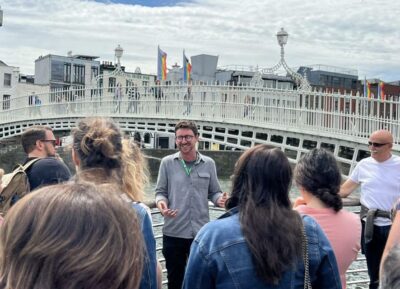
Browse the lists this tour appears in