
Reviewed · HISTORICAL TOURS
2-Hour Historical Walking Tour from Dublin
Two hours, and Dublin clicks into place. You’ll walk from Trinity College to Dublin Castle with a history postgraduate guide who turns big events into street-level stories. It’s also a smart value move because it runs as a small group tour.
What I like most is how clearly the guide explains cause and effect, not just dates. If you luck into guides like Eoin or Jody, you get humor and energy, plus a clear sense of where to go next. One thing to plan for: this tour leans history and politics, and it can feel dense if you expected a lighter, culture-only stroll.
In This Review
- The highlights that matter on the ground
- Entering Trinity College from the Grattan Statue
- Bank of Ireland: Colonial Power, Neoclassical Style
- Temple Bar’s Narrow Streets and the Cultural Quarter Switch
- Wood Quay Amphitheatre: Finding the Viking City Beneath You
- Four Courts and the June 1922 Civil War Start
- Christ Church Cathedral: 1030, Stone Rebuilds, Strongbow
- City Hall Inside: Daniel O’Connell and Catholic Emancipation
- Dublin Castle and the Black Pool Name Thread
- What the Best Guides Do: Clarity, Humor, and a Street-Level Timeline
- Timing, Walking Pace, and Weather Reality
- Price and Value: $22.98 for Context You Can Reuse
- Who This Dublin History Walk Fits Best
- Should You Book This 2-Hour Dublin Tour?
- FAQ
- How long is the 2-Hour Historical Walking Tour from Dublin?
- How much does the Dublin historical walking tour cost?
- Where do I meet the guide?
- Where does the tour end?
- Is entry to the Book of Kells included?
- What is the group size limit?
- What language is the tour offered in?
- What should I wear or expect for walking?
- Is free cancellation available?
The highlights that matter on the ground
Small group pace (max 25): easier questions, easier listening, and fewer tangles at busy corners.
Postgraduate history guides: you get context you can actually use later in the day.
Big landmarks in a tight route: Trinity, courts, cathedrals, City Hall, and Dublin Castle without wasting your morning.
Time-efficient start: finish in time to explore on your own, rather than being stuck on a full-day schedule.
Not all major attractions are included: the Book of Kells entry is not part of the tour.
Entering Trinity College from the Grattan Statue
Your tour starts at the Henry Grattan Monument on College Green, opposite the Trinity College front gate. The key practical detail here is that you’re not roaming around trying to find the group, you’re meant to meet directly at the monument area and then head in. You’ll also want to be a few minutes early, because the walk is timed and the guide has a route to keep moving.
The first stop is Trinity College Dublin, where the big win is how the guide connects the campus to Ireland’s story. You’ll hear about Trinity as Ireland’s oldest university, founded in 1592, and you’ll get pointed toward its most famous manuscript link. That means the Book of Kells, an 8th-century Latin manuscript of the four Gospels, comes up early for context.
Here’s the value angle for you: Trinity is one of those places where it is easy to stare at architecture and miss why it matters. The guide’s job is to make it make sense, so you leave with a mental map, not just photos.
One consideration: entry to the Book of Kells itself is not included, even though you’ll talk about it at Trinity. So if seeing the manuscript is on your must-do list, plan a separate stop after the tour.
Bank of Ireland: Colonial Power, Neoclassical Style
Next you pass the Bank of Ireland, which sounds boring until the guide frames it properly. This building goes back to when it served as Ireland’s colonial parliament, erected in 1729. It was abolished by the Act of Union in 1800, and the story ties it to what the guide describes as the period of Protestant Ascendancy, especially in the 18th century.
Then there’s the architecture. The tour doesn’t treat it like a wall of stone. You’ll get a sense for why neoclassical design fits the mood of the era, and how power announces itself without ever saying a word.
For you, this stop is useful because it gives historical context to something you’ll likely walk past even if you never planned to. If you enjoy understanding the layers behind a city, this is where the tour starts earning its keep.
Time on this stop is brief, about 10 minutes, so come ready to listen, not ready to linger. If you want deeper detail, you’ll still get enough to follow up independently later.
More Guided Walking Tours in Dublin



Temple Bar’s Narrow Streets and the Cultural Quarter Switch
From the formal feel of Bank of Ireland, the tour shifts to the Temple Bar area. The key story here is change over time. This neighborhood was originally earmarked for demolition. Instead, the narrow streets survived and were repurposed as Dublin’s Cultural Quarter in the 1990s.
This stop works well because it shows how cities decide what to save. You’re not only hearing about the past centuries of Ireland, you’re also seeing how modern Dublin brands its identity. It’s a reminder that history is not only old stones and manuscripts. It’s also planning decisions, economics, and public taste.
A practical tip: Temple Bar is often busy and noisy, even when your group is moving through quickly. If you want to keep the stories straight, listen closely early. The tour can be a lot to hold if you chat too much during transitions.
Wood Quay Amphitheatre: Finding the Viking City Beneath You
At Wood Quay Amphitheatre, you get a very different kind of history. This is about archaeology and about Dublin’s early roots. The guide explains that Wood Quay was the site of extensive excavations in the 1980s, uncovering a Viking city.
You’ll hear the key date that pins it: Vikings founded the city around AD 840. That detail matters, because Dublin is often discussed as a medieval city, but this anchors it deeper in time. It also helps you understand why you keep seeing evidence of waves of settlement across the centuries.
What you’ll like here is the way the guide turns what could be a lecture into a location you can picture. Amphitheatre or not, you’re still standing in a place that was physically worked on to reveal earlier layers.
Drawback to consider: because the stop is about 10 minutes, you might want to take a photo, then move quickly. If you stop for long questions here, you may feel rushed elsewhere.
More Irish streets taken slow:
- 90 Minute Dublin Walking tour and Sightseeing tips
★ 5.0 · 916 reviews - Historical 2-Hour Guided Walking Tour of Dublin
★ 4.7 · 865 reviews - Dublin Traditional Irish 3 Course Meal Walking Tour with Local
★ 5.0 · 755 reviews - Dublin: Mythology, Folklore and Legends Walking Tour
★ 4.9 · 703 reviews
Four Courts and the June 1922 Civil War Start
Four Courts is one of the most emotionally loaded stops on the route. The building is Ireland’s legal headquarters, and the guide connects it to the Civil War moment in June 1922. That’s when conflict began between those who supported, and those who opposed, the Treaty of December 1921, which ended the War of Independence from 1919 to 1921.
This part is where the tour’s tone can feel heavier, because it isn’t just “this happened.” It is “this place mattered when it happened.” Courts are symbolic. They also become stages for political conflict.
If you want a deeper understanding of modern Ireland, this stop is a big deal. You’ll likely carry it with you when you read headlines or talk to people later in the trip.
If you’re hoping for a purely cultural walk, this is the point where you should mentally adjust your expectations. One review noted it ran more political and dense than some other European history walks. I think the best approach is to commit to the theme for the full tour, so you don’t feel whiplash.
Christ Church Cathedral: 1030, Stone Rebuilds, Strongbow
Next is Christ Church Cathedral, described as Dublin’s oldest cathedral with roots around 1030. The guide then links a major upgrade to the 1170s, when it was rebuilt in stone by Strongbow. Strongbow, as your guide frames it, was central to the original English invasion of the 1170s.
This is a stop where religious history and political history overlap. The guide’s job is to keep it from turning into a dry timeline. In practice, you’ll probably feel like you’re looking at a building and learning how that building got pulled into bigger struggles.
What to watch for: the stop is about 10 minutes, so you are not doing a long self-guided cathedral visit here. You’re getting the “why this building matters” version first. If you want the architecture and interior experience, plan to come back or build your own time after the tour.
City Hall Inside: Daniel O’Connell and Catholic Emancipation
At City Hall, you’ll step inside to see a statue of Daniel O’Connell, Dublin’s first Catholic Lord Mayor, from 1840. The tour connects O’Connell to Catholic Emancipation in 1829, including the end of anti-Catholic laws. He is widely known, as your guide will tell you, as The Liberator.
This stop adds a different kind of energy to the route. It is less about invasion and state control, more about civil rights and political campaigning in Ireland.
If you like leaders with strong personal stories, this is one of the easiest stops to remember. It also gives you a bridge between the earlier period of British rule and the later 20th-century political conflict you hear at Four Courts.
Again, it is a short stop, about 10 minutes, so listen for how O’Connell’s campaign is framed. That framing helps you understand later changes without needing the tour to repeat every detail.
Dublin Castle and the Black Pool Name Thread
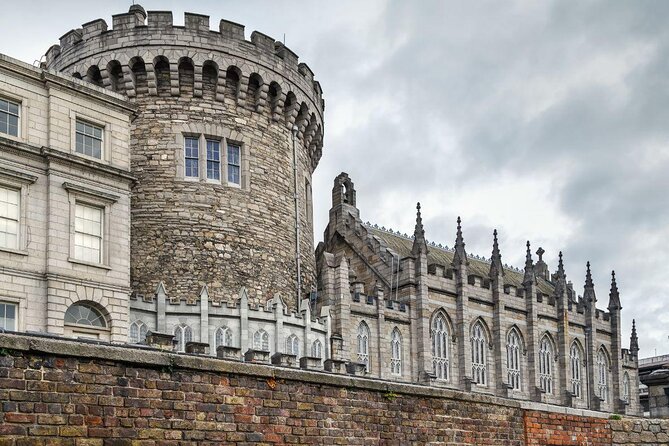
The final walking segment focuses on Dublin Castle. You’ll hear that it was originally built by “Bad” King John in 1204, and that it served as the seat of British administration until 1922.
Then the guide offers a language and place-name story. Dublin gets its name from Dubh Linn, the Black Pool.
This is a clever ending choice. It ties together three things you’ve heard earlier: power, governance, and the long timeline. It also makes the tour end in a way that feels more like a story that connects, not a list of separate stops.
You’ll also finish near Christ Church Cathedral area. That makes it easy to keep exploring without crisscrossing the city for your next activity.
What the Best Guides Do: Clarity, Humor, and a Street-Level Timeline
One reason this tour gets so much high praise is how the guide teaches. People consistently talk about guides who are easy to hear, friendly, and able to balance light moments with serious content. Names that came up include Eoin, Jody, John D., Colm, Daragh, and Caolan Maher.
I also like how some guides start with a rapid overview. One example from the tour experience is Eoin kicking off with an easy-to-follow snapshot of Dublin history stretching back about 5000 years, then building detail stop by stop. That approach matters because it gives your brain a framework. Once the framework is set, the details stop feeling like random facts.
Here’s the practical effect for you: after the tour, you’ll be able to look at a building and ask, What role did this place play? You’ll also know the difference between “it looks historic” and “it’s historically important.”
It’s not an experience for everyone. If you want quick photo stops and light commentary, the density can feel like more than you asked for.
Timing, Walking Pace, and Weather Reality
Plan on about 2 hours. The route is designed to end with you free for the rest of the day. That’s ideal for a first day in Dublin, because it gives you context and direction without stealing an entire afternoon.
The walk is not described as difficult, but it does require a moderate physical fitness level. Also, the route has enough movement that you should wear comfy shoes. One common theme in the experience is that weather can be cold and windy, yet the guides keep things moving.
If you’re traveling in winter or shoulder season, bring a warm layer even if the forecast looks mild. A guide’s voice can only do so much against freezing wind.
Price and Value: $22.98 for Context You Can Reuse
At $22.98 per person, this is priced for value in a big-city setting. You’re paying for two things that usually cost more on your own: (1) a history-focused guide with postgraduate expertise and (2) a route that hits major sites efficiently.
Also, many stops have free admission for the viewing portion. The big exception you should know is the Book of Kells entry, which is not included. So your value math should be: you’re buying the guided framework plus guided orientation at key sites, not the ticketed attraction itself.
If you’re the type who likes to understand why people argue about history, this tour is a bargain. If you’re mostly here for visuals and casual stories, you may feel like you paid for a class. Most people, though, seem to find it worthwhile because it helps them see Dublin as a layered political and cultural city.
Who This Dublin History Walk Fits Best
This tour is a strong match if:
- You want a fast historical orientation for your first visit.
- You like hearing how events link across centuries, from early university and manuscripts to political conflict in the 1900s.
- You enjoy listening to stories, not just taking pictures.
It may be less ideal if:
- You expected a culture-first, low-politics walking tour.
- You get impatient with detail-heavy explanations.
- You’re traveling with very young kids who might not sit through structured history (one comment suggested it may be better for teens and adults).
If you’re a history buff, you’ll likely love the way the guide connects Ireland’s shifts in power to the physical spaces you can stand in.
Should You Book This 2-Hour Dublin Tour?
I’d book it if you want to understand Dublin quickly and then enjoy the rest of your day with better eyes. The route is efficient, the small group size helps, and the guides bring energy and clear storytelling, with humor showing up alongside serious topics.
If you hate politics in any form, or you only want a light city stroll, consider skipping this one. But if you’re okay with a history-forward walk that explains why the city looks the way it does and why it became what it is, this is an easy yes.
FAQ
How long is the 2-Hour Historical Walking Tour from Dublin?
The tour runs for about 2 hours.
How much does the Dublin historical walking tour cost?
The price is $22.98 per person.
Where do I meet the guide?
Meet at the Henry Grattan Monument, College Green, Dublin, Ireland, opposite Trinity College Dublin’s front gate.
Where does the tour end?
The tour ends at Christ Church Cathedral, Christchurch Pl, Wood Quay, Dublin, D08 TF98.
Is entry to the Book of Kells included?
No, entry to the Book of Kells is not included.
What is the group size limit?
The tour has a maximum of 25 travelers.
What language is the tour offered in?
The tour is offered in English.
What should I wear or expect for walking?
You should have a moderate physical fitness level, and you’ll want comfy shoes since it is a walking tour.
Is free cancellation available?
Yes. You can cancel up to 24 hours in advance for a full refund.
Rebellions Retold
- Dublin Historical Centre Food Tour with 8 Food Tastings & Drinks
★ 5.0 · 1,718 reviews - Dublin to Cork, Blarney Castle & Cóbh Heritage Centre by train
★ 4.5 · 510 reviews - Dublin: Jeanie Johnston Tall Ship Irish Famine History Tour
★ 4.8 · 431 reviews - Dublin’s Haunted History Walking Tour
★ 4.3 · 345 reviews
Latest to join the session in Dublin






Historical Tours, compared.

Dublin Historical Centre Food Tour with 8 Food Tastings & Drinks
Read our review →
Historical 2-Hour Guided Walking Tour of Dublin
Read our review →
Dublin to Cork, Blarney Castle & Cóbh Heritage Centre by train
Read our review →
Jeanie Johnston Tall Ship Irish Famine History Tour
Read our review →

Deliciously Dublin: The Artisan Donut Walking & History Tour
Read our review →
Browse the lists this tour appears in