
Reviewed · WALKING TOURS
Dublin: Bucket List Sights Walking Tour
Five stops, one tight Dublin story. This Bucket List Sights Walking Tour turns the main landmarks into a clear timeline, from Vikings and Normans to British rule and Irish independence, with modern Dublin views stitched in. I especially like how the guide connects what you see to why it matters, and I like the way Peter handles questions and even tailors the pace to your comfort level. One thing to consider, though, is that it is a compact, 2-hour walk through central sights, so plan on steady walking and bring something for cool or rainy weather.
You get to start right by the action, meeting across from Christchurch Cathedral near the Bull and Castle, and you finish back at the same spot. The tour’s best value is not just the check-the-box sights, it is the story thread the guide weaves while you’re moving, which helps a first-time visitor get their bearings fast. The only potential drawback is that the guide is English-only, so if you need another language, you’ll want to plan accordingly.
In This Review
- Key Highlights You Should Know
- Getting Oriented Fast in Old Dublin (and Why This Tour Works)
- Christchurch Cathedral, Where Vikings and Later Dublin Collide
- St. Patrick’s Cathedral and the Patron Saint Stories You’ll Keep Hearing
- Dubh Linn Garden, Chester Beatty, and Viking Long Boats
- Dublin Castle, the Center of British Rule (and the Shift After 1922)
- Temple Bar District, Tudor Roots to Live Music Streets
- Views Over the River Liffey, Ha’penny Bridge, and the City’s Long Timeline
- College Green and Molly Malone, the Warm Human Touch
- Trinity College and the Book of Kells Finale
- Price and Value: Why $19 Feels Like a Good Deal for 2 Hours
- Who This Tour Best Fits (and Who Might Want Something Else)
- Should You Book This Dublin Bucket List Sights Walking Tour?
- FAQ
- How long is the Dublin walking tour?
- Where do I meet the guide?
- Where does the tour end?
- How much does it cost?
- Is the tour wheelchair accessible?
- What language is the live guide?
- Is there free cancellation?
Key Highlights You Should Know
- Christchurch Cathedral, tied to Vikings, Normans, and the money trail behind the current building
- St. Patrick’s Cathedral, named for the patron saint story and linked to Jonathan Swift
- Dublin Castle, explained as the center of British government for about 700 years, then transferred after 1922
- Temple Bar District, showing how old Tudor-era Dublin became today’s live music and pub zone
- Trinity College and the Book of Kells, a strong finale that helps you pace the visit
Getting Oriented Fast in Old Dublin (and Why This Tour Works)
Dublin can feel layered, like every street has two or three eras hiding under it. This tour helps you read that layering in motion. You walk from one major site to the next, and the guide keeps returning to a big idea: different groups arrived, ruled or worshipped, built or rebuilt, then left traces you can still spot.
I like that the itinerary is built around places you will actually want to revisit later. By the time you reach Trinity College, you are not just looking at a gate and hoping you remember the name, you understand how the city evolved into its current shape.
Also, the format is practical. You get a live, English-language guide for about 2 hours, and the ending loops you back to the starting area, so you can keep exploring without a confusing “end somewhere else” situation.
Christchurch Cathedral, Where Vikings and Later Dublin Collide
You begin across the road from Christchurch Cathedral, outside the Bull and Castle, and the first impression is about scale and survival. The guide frames the cathedral as a site with deep roots, with Viking-era beginnings in wood, then a shift to stone under the Normans. That matters, because it tells you the building you see today is the latest chapter, not a one-off event.
There’s also a very Dublin detail in the story. You hear about Henry Roe’s whiskey money helping fund the spectacular 19th-century neogothic cathedral you see now. It is a reminder that big architecture often comes from ordinary economic power, in this case, the kind of trade that fueled the city.
One reason this stop is a great start is that it sets your expectations for the whole tour. The guide keeps telling you to look at the same location through different historical lenses, instead of treating each stop like a separate postcard.
More Guided Walking Tours in Dublin



St. Patrick’s Cathedral and the Patron Saint Stories You’ll Keep Hearing
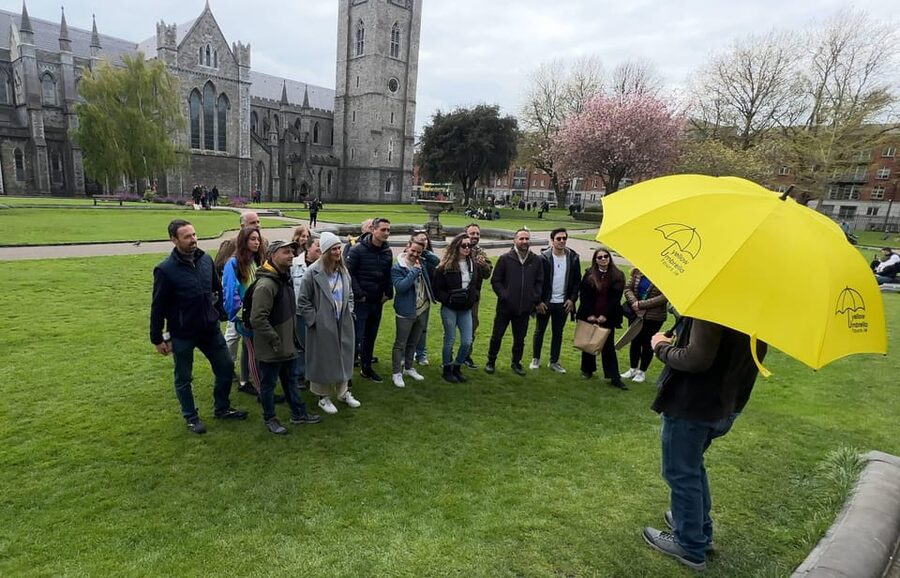
Next comes St. Patrick’s Cathedral, and the tour connects it to Dublin’s patron saint, including the legend about banishing snakes from the island. Legends are not everyone’s thing, but when the guide ties the story to the actual site, the legend becomes a way to understand what people in Dublin wanted to believe.
This stop also lands well if you like literature. The guide points out the burial place of the former Dean, Jonathan Swift, the writer of Gulliver’s Travels. It’s a strong connection because Swift is not just a name you recognize from a book. Here, he becomes part of the city’s physical map.
The tour also explains restoration history, including generosity from Sir Benjamin Lee Guinness in the 1860s. That kind of detail is useful because it answers a common question while you’re standing there: why does a place look cared for, and who paid for that care?
Dubh Linn Garden, Chester Beatty, and Viking Long Boats
After the cathedral stops, you move toward Dubh Linn Garden. This is where the tour shifts from pure monument viewing to “what happened around here” archaeology and settlement logic.
The guide uses the area to spotlight the Chester Beatty Library, plus an important historical anchor: this is described as a place where the Vikings moored their long boats when they arrived in Dublin about 1,200 years ago. Even if you do not know the first thing about Viking ships, the idea that boats came in right here makes the city feel less abstract.
I like that the tour keeps returning to the idea of movement. Dublin is a port story, a river story, and a trade story. When the guide links that to the early settlement, it makes later stops feel less random.
More Irish streets taken slow:
- 90 Minute Dublin Walking tour and Sightseeing tips
★ 5.0 · 916 reviews - 2-Hour Historical Walking Tour from Dublin
★ 5.0 · 875 reviews - Historical 2-Hour Guided Walking Tour of Dublin
★ 4.7 · 865 reviews - Dublin Traditional Irish 3 Course Meal Walking Tour with Local
★ 5.0 · 755 reviews
Dublin Castle, the Center of British Rule (and the Shift After 1922)

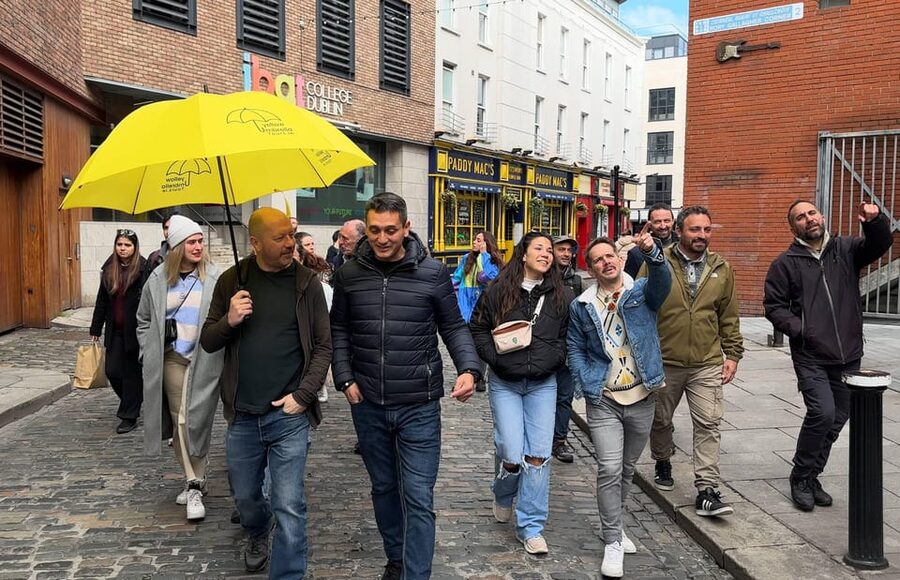
Then you get to Dublin Castle, and this is one of the strongest “big picture” stops on the walk. The tour frames the castle as the center of British government in Ireland for about 700 years, then shifts to independence when it was handed over to Michael Collins and the Irish Free State in 1922.
You do not just hear dates and names. The guide guides your eyes through both lower and upper courtyards, pointing out the mix of medieval and Georgian architecture. That mix is the visual argument of the stop: the British era is not a single style or single moment. It is layers, renovations, and changes in how power presented itself.
There is also a practical payoff here. Once you understand the castle as an administrative hub, you start spotting government and finance references elsewhere in the city more easily, including later stops near College Green.
If you are the type who likes your history tied to real places, this stop does that well without turning the walk into a lecture hall.
Temple Bar District, Tudor Roots to Live Music Streets
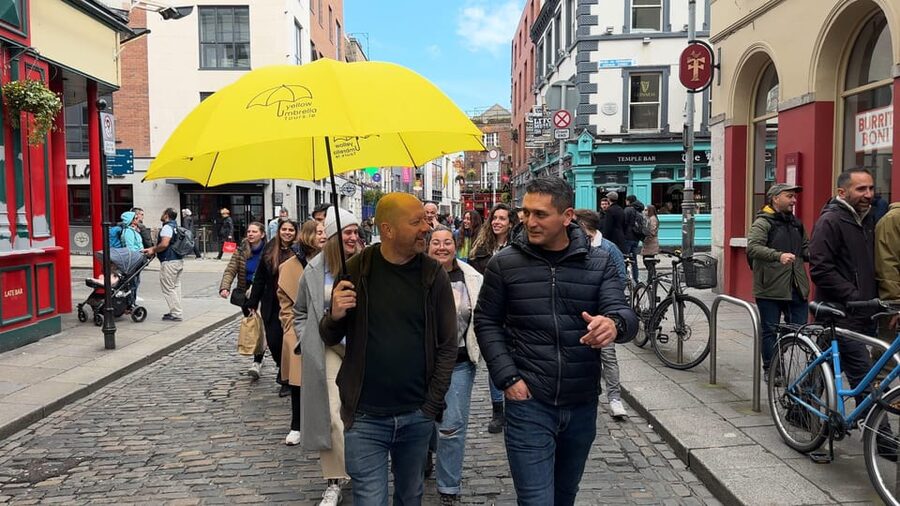
The tour then moves into the Temple Bar District, and the story becomes about survival and reinvention. You see one of the oldest parts of the city dating from the Tudor Conquest in the 16th century. After that, the guide brings it forward to today, describing Temple Bar as the lively center of pubs, live music, and nightlife.
This stop is fun, but it also has a real caution baked into it. Temple Bar is not a quiet museum zone. If you are easily distracted by crowds and noise, you may want to mentally switch from “listening mode” to “people-watching mode” for this segment. The tour still gives you context, it just happens in a lively environment.
The practical value is that you leave with a sense of where Temple Bar starts and where the vibe changes. That helps a lot on your own later nights, because you are not wandering blindly looking for live music.
Views Over the River Liffey, Ha’penny Bridge, and the City’s Long Timeline
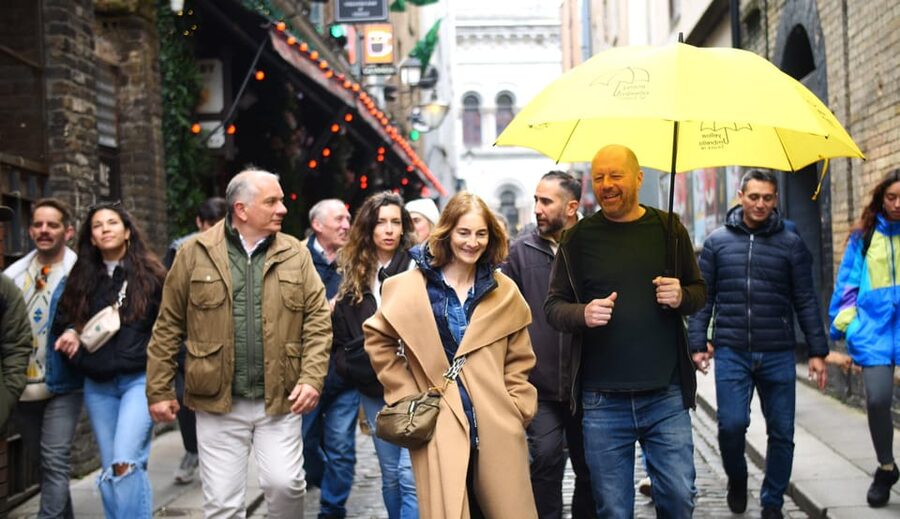
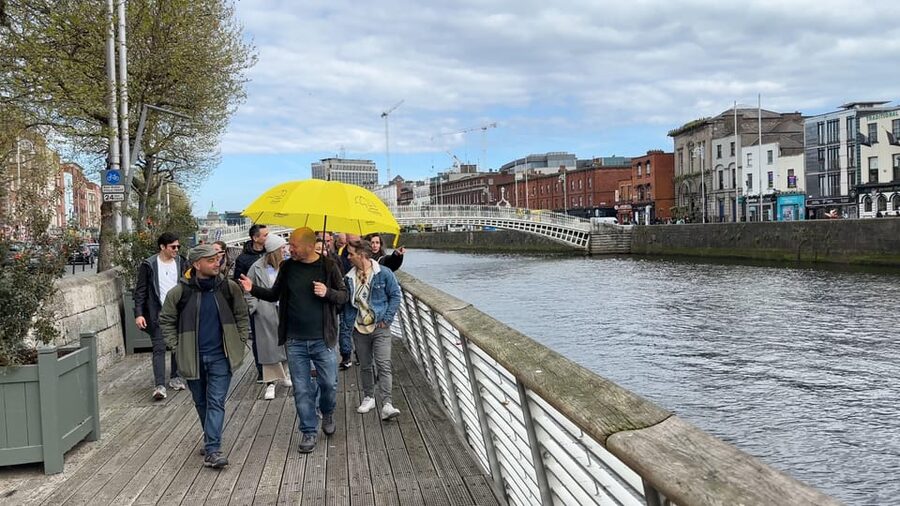
After Temple Bar, you cross the river Liffey for a view of the city stretching from the original Celtic settlement about 2,100 years ago to the Silicon Docks area influenced by Americans in the 21st century. That long timeline move is smart. It reminds you Dublin did not stop at the medieval era, and it gives the “modern Dublin” story equal footing.
Then the walk returns over the iconic Ha’penny Bridge and through Merchant’s Arch onto Crown Alley. Here, the guide brings in Central Plaza and points out Sam Stephenson’s brutalist behemoth. That kind of description matters because brutalism can feel random if you do not know what to look for. Even a basic framing helps you see the architecture as a deliberate style, not just a weird building shape.
This segment also helps you understand the city layout. Bridges, arches, and alley connections can make or break your walking route later, especially if you plan to hop between neighborhoods on foot.
College Green and Molly Malone, the Warm Human Touch
The tour wraps back toward College Green, where you get rewarded with some of the finest neoclassical Georgian architecture in the area, including banks and parliament. The guide frames it as a former center of government and finance, when Dublin considered itself the 2nd city of the Empire. Even if you never fully memorize that title, it signals the scale of Dublin’s historic ambitions.
Right after, you get a familiar name with a local heart: Molly Malone. You see her outside St. Andrew’s Church, and the stop works because it is human-scale folklore mixed into the formal architecture of government zones.
This is the kind of moment that prevents the tour from feeling like only stone and dates. It helps you remember Dublin as a living place with stories people tell, not just a place with buildings you read.
Trinity College and the Book of Kells Finale

You finish outside the front gate of Trinity College, finishing right at the doorstep of its most famous draw: the Book of Kells exhibition. The tour does not stop at the general wow factor. It sets the stage so you can step into Trinity with a sense of why it is such a big cultural anchor.
As a finale, it works well because it gives you a clear next step. Trinity is a natural place to go deeper on your own after the walk, and the tour’s earlier history context makes the visit feel connected instead of separate.
If you only have a short time in Dublin and want a good first-day structure, ending here is a sensible plan. You can decide on the fly how long you want to linger, and the walk has already done the orientation work for you.
Price and Value: Why $19 Feels Like a Good Deal for 2 Hours
At about $19 per person for a 2-hour guided walk, this tour is priced like an efficient introduction. You are paying for a live local guide, not just the right to stand near landmarks. And the guide’s real value shows up in the details: how the story connects across stops, how questions get answered, and how pacing is adjusted when someone’s English level needs it.
In other words, you are not just buying a route. You are buying a mental map. That is what makes a budget-friendly tour feel worthwhile.
If you are in Dublin for a day or two and want a fast overview that you can build on later, this is the kind of value that makes sense. The sights are major, and the guide turns them into context you can carry into the rest of your itinerary.
Who This Tour Best Fits (and Who Might Want Something Else)
This walking tour is a good fit if you want to:
- See the core Dublin highlights in a short window
- Learn the city’s timeline in plain language while walking
- Ask questions and get practical advice for the rest of your stay
It also seems especially helpful for language comfort. The guide is noted for adapting the tour to a visitor’s English level, and for being willing to answer additional questions. That personal touch makes a difference when you are traveling without a huge buffer of time.
It may be less ideal if you want a slow, quiet stroll focused on photography only, because some stops, especially Temple Bar, can be lively and crowded. It also has a fixed English guiding format, so plan around that if you need another language.
Should You Book This Dublin Bucket List Sights Walking Tour?
Yes, I think you should book it if you are trying to make your first days in Dublin feel organized and meaningful. The tour’s strongest advantage is how it links each stop into a coherent story, instead of treating every landmark like an isolated photo op. You also get that human factor, with Peter in particular described as kind, attentive, and tuned into the needs of the group, including language comfort and extra recommendations.
I would skip it only if you already have a full day planned that includes all of these sites, or if you prefer very independent travel with minimal guiding. Otherwise, this is a smart way to start, especially if your goal is to understand Dublin quickly and then wander with confidence.
FAQ
How long is the Dublin walking tour?
The tour duration is 2 hours.
Where do I meet the guide?
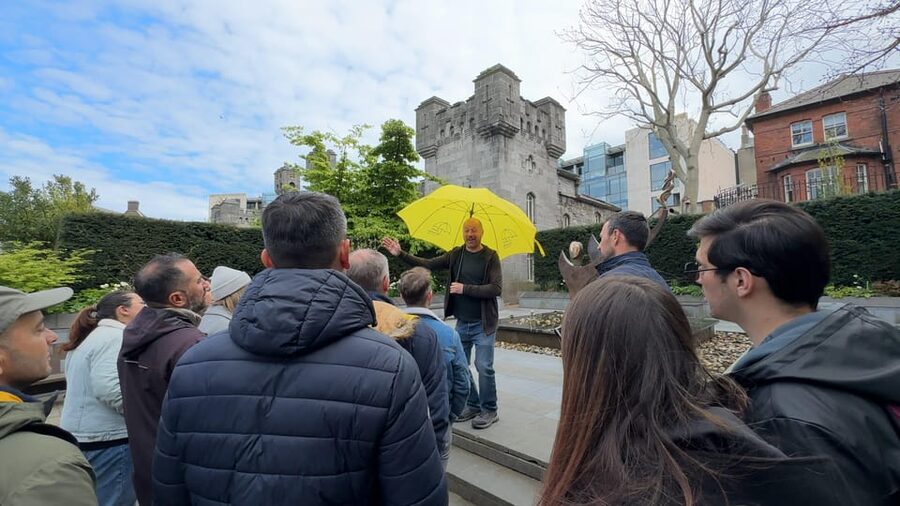
Meet your guide across the road from Christchurch Cathedral, outside the Bull and Castle. Look for the yellow umbrella.
Where does the tour end?
The tour ends back at the meeting point across from Christchurch Cathedral.
How much does it cost?
The price is $19 per person.
Is the tour wheelchair accessible?
Yes, the tour is wheelchair accessible.
What language is the live guide?
The live tour guide is in English.
Is there free cancellation?
Yes. You can cancel up to 24 hours in advance for a full refund.
Latest to join the session in Dublin






Walking Tours, compared.
Dublin Highlights and Hidden Gems Guided Walking Tour
Read our review →
90 Minute Dublin Walking tour and Sightseeing tips
Read our review →

Historical 2-Hour Guided Walking Tour of Dublin
Read our review →
Dublin Traditional Irish 3 Course Meal Walking Tour with Local
Read our review →
Browse the lists this tour appears in