
Reviewed · WALKING TOURS
Dublin: Hidden Gem Walking Tour with Local Guide
Tallaght history hits hard in two hours, and it stays human the whole way. I like how the walk threads letters and friendships through real Dublin names, then turns them into stories you can actually picture. I also like that you leave with Irish phrases you can try right away, not just facts on a screen. One drawback to keep in mind: this tour is focused on Tallaght, so it is not the classic central-city highlights route.
Expect a tight group, led by local guide Sophie, with lots of conversation and some shared visuals like photographs and excerpts. Each stop is mostly outside and spread across neighborhoods, so bring layers and plan for changeable weather since the experience requires good conditions.
In This Review
- Key things that make this Tallaght walk work
- Tallaght turns into a time machine
- Price, time, and why 18.05 feels fair here
- Kingswood Heights to Whitehall, where Tallaght’s deeper roots begin
- William Howard Russell, war reporting, and Dickens links in Tallaght
- Myth plus a mountain view: Oisín in Tír na nÓg
- Tallaght Aerodrome, Urneys Chocolates, and the story of industry
- TU Dublin Tallaght and the fast growth of the 1970s-80s
- St Maelruain’s Church, two eyes of Ireland, and Alice Furlong
- Tallaght Village, Fenian Rising 1867, and a tram line footnote
- What to expect on the walk and how to prep
- Should you book this Tallaght walking tour?
- FAQ
- How long is the Dublin Tallaght walking tour?
- What is the price per person?
- What language is the tour offered in?
- Is a mobile ticket included?
- Where does the tour start and end?
- How large is the group?
- Are there admission tickets required at the stops?
- Is the tour accessible to most travelers?
- What should I do if the weather is bad?
- What is the cancellation policy?
Key things that make this Tallaght walk work
- Small group size (max 12) keeps it conversational and question-friendly
- Local guide Sophie connects places to people, not just dates
- Bilingual storytelling includes an Irish and English version of Oisín in Tír na nÓg
- Real-world documents are shared, from letters to writing excerpts during key stops
- A practical Irish-language send-off ends at a café where you can use what you learned
Tallaght turns into a time machine
Dublin usually gets sold as a postcard loop, but this tour takes the city’s quieter side and puts it on the mic. You start in the Kingswood Heights area, then work through Tallaght’s older layers, its literary connections, and its 20th-century changes. By the end, you are not just looking at buildings, you are understanding how a place grows, reshapes, and remembers.
I love tours that make geography feel personal, and this one does that with named figures tied to specific corners. You get links between Irish literary circles and famous journalists, plus mythology that connects to the Dublin Mountains view. It is the kind of storytelling where the route itself becomes the lesson.
You also get a gentle push toward Irish language practice. Even if your Irish is rusty, the tour teaches basic phrases and encourages you to use them right in Tallaght Village.
Price, time, and why 18.05 feels fair here
At about $18.05 per person for roughly two hours, the value comes from what you get per minute, not just the ticket cost. The timing is tight, the group stays small, and the stops are designed around short, focused stories with shared written material.
Also, most stops are ticket-free, so you are not paying again at each location. For a walking tour, that matters. You can spend the money on the guide, the storytelling, and the context, not on entry fees.
One practical note: the tour is commonly booked around a month in advance. If you are traveling in peak season or on a limited schedule, try booking early so you get the time slot you want.
More Guided Walking Tours in Dublin

Kingswood Heights to Whitehall, where Tallaght’s deeper roots begin
You begin in Kingswood Heights near Kilnamanagh, and the guide sets the tone fast. Before the walk gets into specific personalities, you get a quick orientation to Tallaght and its beginnings in ancient Irish history. It is a good way to stop thinking of Tallaght as just an outer suburb and start treating it like its own historical setting.
From there, you move to the former residence of Katharine Tynan, linked with Whitehall. This is where the tour’s literary thread gets real. You learn about Katharine Tynan’s life and her role in Irish and English literary circles, including how AE described her as an early voice in the imagination awakening that later became associated with the Irish Renaissance.
The guide shares letter contents between Katharine Tynan and major figures like W. B. Yeats, plus AE (George William Russell), who would frequent Whitehall. If you like your history grounded in actual words, this is a highlight. It turns famous names into people with conversations, friendships, and influence.
Time-wise, this portion is short, but it is information-dense in a friendly way. I like that the tour does not require you to already know the cast of characters.
William Howard Russell, war reporting, and Dickens links in Tallaght
Next, you head near Belgard Road and learn about William Howard Russell, born in Jobstown, Tallaght. This is one of those stories that quietly expands your idea of who came from the Dublin region and what they later shaped.
He is considered among the first war correspondents, and his name becomes tied to reporting that spanned major conflicts and turning points. You hear how his early life in Tallaght fed into a long reporting career, with emphasis on work for The Times. The guide connects his reporting to events ranging from Daniel O’Connell’s meetings through the Great Famine, then onward to the Crimean War and the American Civil War.
What makes this stop more than trivia is the human connection. The tour briefly covers his friendship with Charles Dickens. Even if you only know Dickens from novels, it adds a layer. Suddenly, Dublin’s outskirts connect to the broader Victorian news world, not just local legends.
If you are the type who likes cause-and-effect history, this segment gives you that. A place shapes a person, and a person shapes stories that shaped public opinion back home.
More Irish streets taken slow:
- 90 Minute Dublin Walking tour and Sightseeing tips
★ 5.0 · 916 reviews - 2-Hour Historical Walking Tour from Dublin
★ 5.0 · 875 reviews - Historical 2-Hour Guided Walking Tour of Dublin
★ 4.7 · 865 reviews - Dublin Traditional Irish 3 Course Meal Walking Tour with Local
★ 5.0 · 755 reviews
Myth plus a mountain view: Oisín in Tír na nÓg
One stop shifts gears into Irish mythology. Before getting specific, you get background context, which helps if mythology is not your strongest subject. Then you hear the legend Oisín in Tír na nÓg, also presented in a bilingual Irish and English version.
The guide also connects the legend to Dublin Mountains and uses the view from the area to make the story feel grounded. You are not just reciting a myth. You are seeing how local geography can sit inside older narratives.
Time at this point is brief, so you do not get lost in details. The goal is comprehension and a memorable image. If you like myth explained in plain language, this is a great mid-tour breath.
Tallaght Aerodrome, Urneys Chocolates, and the story of industry
At Belgard Retail Park, the tour brings you into the layered history of land and work. You learn about the former Tallaght Aerodrome, including its role across WW1, the Irish War of Independence, and the Irish Civil War. Then the guide connects that land to Katharine Tynan’s family, since the aerodrome was built on lands that belonged to her father, and a poem by Katharine is shared.
After that, you hit a more everyday kind of history: the Gallagher family and Urneys Chocolates. You get the story of how Urneys Chocolates found its home in Tallaght and helped shape local life for decades, before closing in 1980. The tour also touches on how the brand lives on today.
Another brand gets a quick mention too, Jacob’s, which operated in Tallaght for a time. Taken together, these stops explain why towns grow the way they do. Industry brings jobs, people, routines, and local identity. When factories close, the story changes, but traces remain.
This is one of the stops where I think the pacing works best. The aerodrome story gives you national-scale conflict context, while the chocolate story brings you back to daily life and the economy of place.
TU Dublin Tallaght and the fast growth of the 1970s-80s
You then move to TU Dublin, Tallaght Campus, and the tour zooms in on transformation. You learn how Tallaght changed in just a few decades, especially during the 1970s and 1980s, when it became one of the largest urban areas in Ireland. The guide also highlights that Tallaght was one of the fastest growing urban centres in Western Europe during the 1980s.
The tour does not stop at numbers. It explains the impact on people in a wider Ireland context, including economic difficulties, high unemployment, and high emigration. That angle matters, because it shows you how an urban boom can exist alongside real hardship.
This section helps you connect what you see today, housing and campus life, to what was happening underneath. It is a reminder that urban sprawl has a human cost and a human story.
If you like tours that make you look at neighborhoods differently when you are done, this is the part that sticks.
St Maelruain’s Church, two eyes of Ireland, and Alice Furlong
The tour then goes to St Maelruain’s Church of Ireland, which stands on the site of a former monastery. You hear about ancient importance, including the idea that, along with a monastery at Finglas, it was known as two eyes of Ireland. You also learn about St Maelruain himself and how the present church came into being.
Then, you stay in the same church grounds for the story of Alice Furlong. You learn she is buried there, and until recently her memory was lost to time. The guide shares her life: founding member and vice-president figures connected to Inghinidhe na hÉireann, also known as Daughters of Ireland. You also learn she was a poet and writer, and an Irish-language advocate with a love for Tallaght.
This stop includes poetry. The guide shares works in Irish, and provides professional translations into English. That translation detail matters, because it lets you respect the original language without feeling shut out.
If you want Irish cultural history that goes beyond monuments, Alice Furlong is a powerful anchor. It brings language, leadership, and local pride into the same story.
Tallaght Village, Fenian Rising 1867, and a tram line footnote
You finish around Tallaght Village at the Village Green, starting with a plaque commemorating the Fenian Rising of 1867. The guide walks you through Tallaght’s role in that uprising and shares Dickens writings connected to the period.
Next, you end at the Village area where you see cottages designed by architect Thomas Joseph Byrne, described in the tour as one of the most influential architects of the day. It is a nice way to close the loop. You go from national rebellions to the built details people actually lived in.
The tour also briefly mentions the Dublin and Blessington Steam Tramway, which ran through the area and closed in 1932. Even though it is a quick note, it helps you picture how people moved through Tallaght before modern commuting patterns took over.
Then comes the practical finish. You are taught some basic Irish, then invited to try what you learned at a local café right in Tallaght Village. That small action turns language from theory into a tiny experience.
What to expect on the walk and how to prep
This is a guided walking tour with a small group cap of 12. The total time is around two hours, and the story beats are designed around brief stops, each with shared excerpts, letters, or translations.
Because the experience requires good weather, you should plan for outdoor walking. Wear comfortable shoes and bring a light layer, especially if you are traveling in shoulder season or cooler months. If you are sensitive to crowds, the small size helps, and it also makes questions feel normal.
Transport is convenient in the sense that it is near public transportation. Service animals are allowed, so if you rely on one, you can plan without extra hassle.
Should you book this Tallaght walking tour?
Book it if you want a Dublin experience that feels off the usual route, but still deeply connected to Ireland’s writers, myth, and political eras. I especially recommend it if you care about how places link to people, like Katharine Tynan’s friendships with W. B. Yeats and AE, or William Howard Russell’s war correspondence career, or Alice Furlong’s Irish-language work.
Skip it if you mainly want top-of-list Dublin sightseeing and tight photo stops in central areas. This tour is about Tallaght specifically, so your reward comes from paying attention to a neighborhood that many visitors overlook.
If you do book, do it with a simple mindset: take notes if you like, ask questions when Sophie offers room for them, and use those basic Irish phrases at the café. That is the kind of small effort that makes the walk last longer after you leave.
FAQ
How long is the Dublin Tallaght walking tour?
The tour runs about 2 hours.
What is the price per person?
The price is $18.05 per person.
What language is the tour offered in?
The tour is offered in English.
Is a mobile ticket included?
Yes, the tour includes a mobile ticket.
Where does the tour start and end?
It starts in Kingswood Kilnamanagh, Dublin, and ends in Tallaght Village by R819, near a bilingual Irish/English café.
How large is the group?
The tour has a maximum of 12 travelers.
Are there admission tickets required at the stops?
Admission tickets are listed as free for the stops included in the tour.
Is the tour accessible to most travelers?
Most travelers can participate.
What should I do if the weather is bad?
The experience requires good weather. If it is canceled due to poor weather, you will be offered a different date or a full refund.
What is the cancellation policy?
You can cancel for free up to 24 hours in advance for a full refund. Cancellations made less than 24 hours before the start time are not refunded.
Latest to join the session in Dublin




Walking Tours, compared.
Dublin Highlights and Hidden Gems Guided Walking Tour
Read our review →
90 Minute Dublin Walking tour and Sightseeing tips
Read our review →
Historical 2-Hour Guided Walking Tour of Dublin
Read our review →
Dublin Traditional Irish 3 Course Meal Walking Tour with Local
Read our review →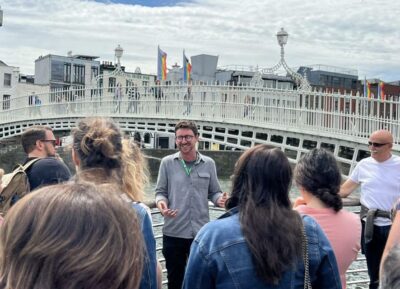
Browse the lists this tour appears in