
Reviewed · HISTORICAL TOURS
Galway Historic city Tour – 2.5hr Family & Friends Private groups
Galway can feel like a movie set, if you know where to look. This private 2.5-hour historic walking tour connects the dots from old walled city days to today, with plenty of story time as you move. You start in the big open heart of Eyre Square, then wind through medieval streets where the places still shape the city.
I especially liked how small-group the experience is, so your guide can slow down for questions and let you stop for photos. I also loved the mix of big-name sights and side lanes, including 700-year-old St Nicholas’ Collegiate Church and Lynch’s Castle, plus local legends like Bloomsday links.
The main thing to consider is the pace. It is a walking tour, and you will spend most of the time on your feet, so plan for weather and comfortable shoes.
In This Review
- Key things that make this tour worth your time
- Hardiman Hotel Meet-Up and Eyre Square, Galway’s Starting Point
- A Small Group Means You Can Actually Ask Questions
- Stop 1 to 4: Eyre Square to Medieval City Walls
- Europe’s Newest Stone Cathedral and the River Corrib Pause
- Lynch’s Castle, Courthouse Square, and the Old Town Network
- St Nicholas Collegiate Church and the Columbus Story
- Nora Barnacle, Bloomsday, and Galway’s Writer Connections
- King’s Head Pub Legends and the Medieval Latin Quarter Streets
- Lynch Memorial Window, Quay Street Energy, and the Long View Across the Water
- Claddagh Across the River: Fishing Village Life and Claddagh Ring Roots
- Spanish Parade and the Spanish Arch, Trade Routes You Can Feel
- Hall of the Red Earl and Archaeology Under Your Feet
- Naughton’s Pub, Humanity Dick Martyn, and a Choice to Toast
- An Taibhdhearc and Galway Culture After Dark
- The Final Cathedral Building on Abbeygate Street Lower
- Is the Price Worth It? $360.93 per Group for a Pro-Led Walk
- Should You Book This Galway Historic City Tour?
- FAQ
- FAQ
- Where does the tour start?
- How long is the walking tour?
- What is the group size limit?
- What is included in the price?
- Do I need tickets for anything else along the route?
- Are drinks or meals included?
- What happens if the weather is bad?
- Is it suitable for families and kids?
Key things that make this tour worth your time
- Eyre Square orientation first, so the rest of Galway makes sense fast
- 700-year-old St Nicholas’ Collegiate Church plus a ticket option for its guided tours
- Lynch’s Castle and medieval street clues, including graveyard history around Market Street and the old churchyard areas
- Corrib views from bridge spots, with the Claddagh settlement story across the river
- Real pub and culture stops, including the King’s Head Pub legend and An Taibhdhearc theatre
- A guide who works the route, with the flexibility to adapt with your group’s interests
Hardiman Hotel Meet-Up and Eyre Square, Galway’s Starting Point
Your tour starts at the front entrance of the Hardiman Hotel, right in Eyre Square. The meeting spot matters here, because Eyre Square is the clean “map” for Galway. Once you stand there with your guide, you get a simple overview of how Galway grew from a Gaelic settlement on the west coast into a prosperous walled city.
From the start, I like the way your guide names what you are looking at, not just what you are walking past. You get context for landmarks that would otherwise feel like random plaques. You will also hear about the 14 Tribal merchant families of Galway, which helps explain why so many buildings and symbols show up around the square.
As you look around, you’ll pass and talk about things like the old Browne Doorway, the Tribes of Galway banners, the John F Kennedy memorial, and the Quin-centenary Fountain. You also get the big picture for Galway’s political and trade swings over centuries, including the city’s change from merchant power to modern life.
If you like a good first stop that sets the tone, Eyre Square does that job quickly.
A Small Group Means You Can Actually Ask Questions
This tour is built for families and friends in a private group format. The group is limited to 17 participants, and the price is set per group (up to 15). That small number is a real advantage, because it lets the guide keep moving without rushing everyone, and it keeps your conversations from turning into background noise.
In practical terms, you should expect:
- stops with time for photographs
- space to interact, ask about local details, and get suggestions
- a walking rhythm that works for a range of ages, since it is described as family-friendly and even animal-friendly
One thing I appreciated from the experience is that the guide can adjust if your group wants a particular focus. You might want more time on the medieval parts, or you might prefer the stories tied to writers and Irish culture. Either way, your guide is set up to guide the flow, not just march you through.
More Private Tours in Galway

Stop 1 to 4: Eyre Square to Medieval City Walls
After Eyre Square, you head toward Williamsgate Street. This area is where elegant storefront energy meets old Galway identity. You will pass notable buildings like the Browne Thomas building, and the guide points out shops specializing in Galway Claddagh rings. If timing allows, you may stop at an Oscar Wilde statue, described as an Estonia gift to Ireland in 2004.
Then you shift toward the Franciscan area. A highlight here is the Franciscan Church, tied to the Friary. The guide talks about its history and you can see a graveyard behind the church, which was a prominent burial place in the mid-17th and early 18th centuries. Even if you are not a “church-history” person, the graveyard detail gives you a human scale for how old Galway feels.
Next comes the Eyre Square Centre, where you view impressive medieval city walls from the 13th century. This is one of those moments where the city stops being “pictures” and becomes physical. You are standing near defensive architecture that connects to why Galway became so important to trade and power.
If you want good orientation and clear visuals early on, this sequence is strong. You go from open square into walls and churchyard ground you can actually picture later.
Europe’s Newest Stone Cathedral and the River Corrib Pause
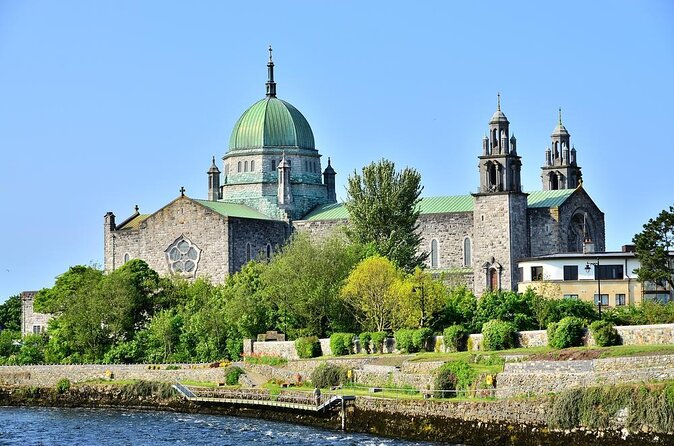
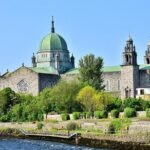
From there, you walk toward the Galway Cathedral area, with a pause planned near a newly constructed pedestrian bridge over the River Corrib. Your group pauses to view Galway Cathedral and the Franciscan Chapel.
This stop is useful because it breaks the medieval streak with a modern landmark, so your mental timeline stretches forward. It also gives you a change in scenery. Corrib air and a bridge view make it easier to reset before the more compact medieval lanes.
A quick practical note: bridge and river viewpoints can be breezy. If the day is warm, bring a light layer anyway.
More rebellions retold in place:
- Galway: Dark History Guided City Walking Tour
★ 4.8 · 236 reviews - The Dark History Tour of Galway City
★ 5.0 · 146 reviews - Galway City on Foot with Seán: Stories, History, Local Tips, Chat and More..
★ 5.0 · 64 reviews - Galway History Walking tour with Local expert – Private Group
★ 4.5 · 26 reviews
Lynch’s Castle, Courthouse Square, and the Old Town Network
The walk returns via the River Walk toward the main city artery. You arrive at Lynch’s Castle, described as the oldest building in the city and the finest surviving Town-Castle in Ireland. This is a big stop, and the guide explains its story as a former ancestral home of the powerful Lynch clan up until the mid-17th century.
What makes Lynch’s Castle extra interesting is the guide’s attention to specific architectural clues like crests and roundels. That helps you look at the building instead of just glancing.
From Lynch’s Castle, you continue toward Market Street and the area around Church Lane, once called Dead Man’s Lane. The “why” is the point here, since funerals passed through that route into the old graveyard. Then you move toward Courthouse Square.
Courthouse Square tells a different side of Galway’s story. You will learn about the two iconic courthouses that once existed, one for the county and one for the city, and you will see one courthouse remains. The Town Hall Theatre sits opposite, so you get a neat contrast between law, administration, and the arts.
If your brain likes cause and effect, this part of the route is satisfying. You start seeing Galway as connected neighborhoods, not isolated attractions.
St Nicholas Collegiate Church and the Columbus Story
St Nicholas’ Collegiate Church is a must-do sight in Galway, and this tour builds in a meaningful time stop. The church is described as 700 years old and is the largest medieval church in continuous use in Ireland. Your guide explains how its role shifted, starting as a Catholic church and now functioning as a Protestant church.
There are a few standout story beats tied to this stop:
- In 1477, Christopher Columbus is said to have worshipped here before his voyage
- You will be offered discounts to join guided tours that operate on Mon-Fri at 11am and 2pm, and Wednesdays at 12pm and 3pm
- If your visit falls on a Saturday, you can sample the Saturday Market (8am to 4pm) just outside the church area
That last detail is a great “plan for luck” feature. Even if you do not care about markets, it adds a lively local-feeling layer around the church precinct.
One more practical thing: the included part notes admission for this stop. If you want the inside tour moments, it is worth aligning your timing with the guided tour schedule the guide provides.
Nora Barnacle, Bloomsday, and Galway’s Writer Connections
As you keep walking through the old town and Latin Quarter area, you pass close to Bowling Green, tied to Nora Barnacle, a prominent Galwegian connected to James Joyce. You will hear that she dated Joyce on 16 June 1904, a date now famously called Bloomsday.
The guide also points out that Nora Barnacle House is believed to be Ireland’s smallest museum. Even if you do not pop inside, knowing it is right there changes how you experience the area, because you start seeing the city through its literary connections.
This part of the tour works especially well if you enjoy Ireland beyond pubs. It makes cultural history feel physical, not abstract.
King’s Head Pub Legends and the Medieval Latin Quarter Streets
Next up is Galway’s Latin Quarter around High Street, including a stop near the iconic King’s Head Pub. The legend here is that the pub site was gifted by Oliver Cromwell as payment to the executioner of King Charles I.
It is the kind of story your guide can tell with enough care that it feels like folklore you can actually remember. Nearby, you pass Naughton House, once owned by an Irish MP in the British Parliament known as Humanity Dick Martyn. Your guide connects names on the street to the kinds of power Galway had over time.
As you walk, you will also get a sense of what stays the same and what changes: same narrow corridors of movement, new layers of nightlife and daily life.
If you have ever wished a walking tour would show you where you would actually eat, this is one reason this route gets strong praise. In the guide-led experience, the route includes places where locals have a history, and the guide can point you toward good stops that do not feel like tourist traps.
Lynch Memorial Window, Quay Street Energy, and the Long View Across the Water
The Lynch Memorial is a popular stop, and the guide explains a 15th-century legend tied to a memorial window erected in 1854. The story involves Mayor James Lynch FitzStephen and a rivalry that ends in tragedy, with the son paying the ultimate price. Whether you fully catch every name, the point is clear: Galway’s past lived in stories that got memorialized in stone and glass.
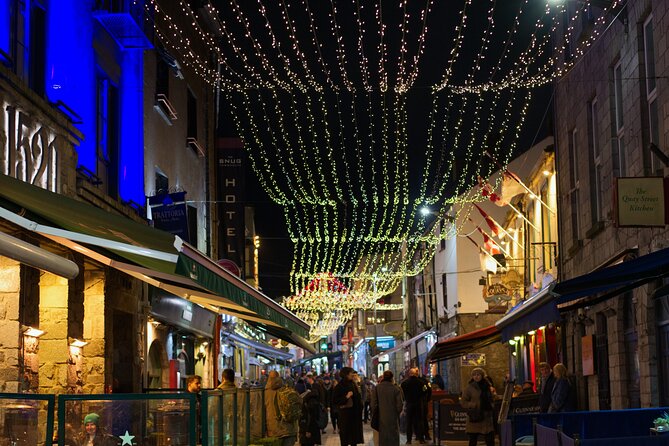
Then you head to Quay Street, where life concentrates. The guide describes it as central to Galway life for almost 600 years since the city was founded. You will see pubs, restaurants, cafes, lots of music, and you also pass references tied to a medieval castle and the Claddagh Ring Museum, plus a building that housed Galway’s first nightclub.
After Quay Street, you get a viewpoint over the River Corrib from the Wolfe Tone Bridge. From here, you can see the Claddagh Village across the river. This is where the tour starts talking about Galway beyond the walled city.
Claddagh Across the River: Fishing Village Life and Claddagh Ring Roots
The Claddagh story is a highlight because it gives you Galway’s origin point for both culture and craft. The guide explains that Claddagh was an old Gaelic settlement outside the walled city, described as a fishing village with about 3,000 people.
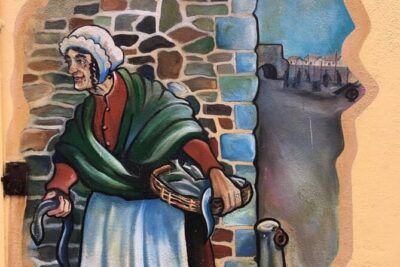
You will hear that fishermen sailed from Galway Bay in old Galway Hooker boats, and the women later sold fish on the Spanish Parade area. That connection matters, because it helps explain how the Claddagh name became tied to the famous Claddagh Ring.
This is a good pause for photos too. It is one of those “step back and look” moments that prevents your brain from feeling too locked into street-level detail.
Spanish Parade and the Spanish Arch, Trade Routes You Can Feel
You move into the Spanish Parade area, described as a space where the old Galway port once operated. The guide explains that up to about 1660, Galway had brisk foreign trade with France, Spain, and Portugal. Ships frequented the area with goods like wines and spices for the merchant families.
Then you see the Spanish Arch along the banks of the River Corrib. You might not expect trade history to feel like a place, but the stories make the arch and surrounding ground more than just a photo stop.
The key is that your guide ties money, ships, and family power to a specific physical spot.
Hall of the Red Earl and Archaeology Under Your Feet
Next is the Hall of the Red Earl. It is described as a medieval Norman site once used as a castle residence of Richard de Burgo, important until the late 16th century. The ruins were lost for centuries and were discovered again by archaeologists in the late 1990s.
This stop has a special kind of “wait, that’s real?” energy, because it reminds you that Galway is still being uncovered. If you love seeing how history gets found and reinterpreted, this is the moment.
It is also a nod to why a guided walk helps. Left on your own, you might miss the significance of what you are standing near.
Naughton’s Pub, Humanity Dick Martyn, and a Choice to Toast
Your tour continues to Naughton’s Pub, Tig Neachtain. The guide shares a story about Richard Martin, known as Humanity Dick Martyn. Early in life, he was a duellist nicknamed Hairtrigger Dick. Later he was elected as Galway’s representative in the British Parliament and introduced animal rights laws, leading to the setting up of the SPCA.
If your group wants, the guide can return to the pub area later during the walk for drinks, but that is at your own expense. Even without going in, this stop works because it ties moral reform and politics to a very everyday place.
Then there is a possible detour onto Kirwan’s Lane off Quay Street if Quay Street is too busy or if time allows. This lane is named after a Gaelic tribal family and offers a quieter streetscape. The guide also notes the site of the former Richard Humanity Dick Martin Theatre.
I like that these side routes give you a choice. You can get the main action or step into a calmer medieval lane depending on how your group feels.
An Taibhdhearc and Galway Culture After Dark
Your last city-walk stages pass by An Taibhdhearc, Ireland’s only Irish-language theatre. The guide explains it was established as a large-scale cultural project in the early 1920s when Ireland became a Free State, with Micheal MacLiamor as the first director or manager working there from 1928.
Even in a short stop, this gives you a clear sense that Galway is not only old. It actively builds culture, and it does that in Irish language and theatre in a visible way.
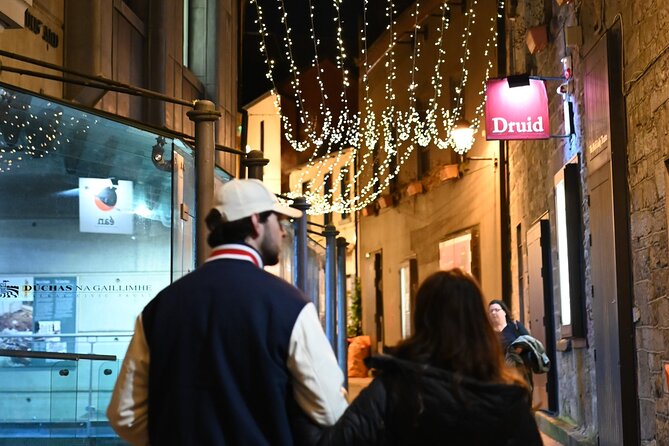
Your guide also points out the Druid Theatre Company connection in 1975, founded by university graduates in Galway, and the important relationship with writers Tom Murphy and Martin McDonagh, plus the ongoing work of well-known actors and directors with the company.
The Final Cathedral Building on Abbeygate Street Lower
The tour ends around Middle Street and Abbeygate Street Lower, at an old Galway Cathedral building near that junction. The guide explains it was used for many centuries, then declared inadequate by Galway bishop Dr Michael Browne.
When the route ends, you have a choice. You can remain in the Old Town or Latin Quarter area on your own, or return toward central Eyre Square with your guide. That flexibility matters because after a 2.5-hour walk, you might want to keep exploring at your own pace.
Is the Price Worth It? $360.93 per Group for a Pro-Led Walk
Let’s talk value, because this is where people hesitate with private tours.
At $360.93 per group (up to 15), you are paying for a professional guide and a walk designed for your time together. For a party large enough to fill the group, the cost per person can feel reasonable compared with multiple individual tickets or taking separate private outings.
This price also buys you:
- a private group format instead of being swallowed by a larger crowd
- time for photos and interaction, not just a rushed checklist
- built-in context that helps you understand why Galway looks the way it does
There is one practical tradeoff: your “value feeling” depends on how many people you bring. If your group is small, you might feel the cost more strongly. Still, if you want a guided story for key landmarks like St Nicholas’ Collegiate Church and Lynch’s Castle, having one guide connect the dots can save you time and confusion.
Should You Book This Galway Historic City Tour?
Book it if you want a guided walk that gives you a real sense of how Galway formed, not just a list of sites. This route is ideal for first-timers who want orientation, for families who do better with a paced story, and for groups who enjoy local legends mixed with architecture and street-level history.
Skip it or consider timing carefully if you are not comfortable walking for much of the experience, or if weather is unpredictable. The tour is described as requiring good weather, and that matters more for a walking route than for a seated museum day.
If you want a memorable Galway walk that mixes major landmarks with the kinds of side streets you would not easily find alone, this one is a strong pick, and the guide-led stories around places like St Nicholas and the Hall of the Red Earl make it feel more personal than a standard overview.
FAQ
FAQ
Where does the tour start?
It meets at the FRONT entrance of the Hardiman Hotel in Eyre Square, Galway (H91 NFD2).
How long is the walking tour?
The duration is about 2 hours 35 minutes.
What is the group size limit?
The tour is for small private groups, limited to 17 participants.
What is included in the price?
You get the professional guided city tour and a discount ticket option to visit St Nicholas Collegiate Church (for 10am tours only). Admission is listed as included for St Nicholas’ Collegiate Church on the tour.
Do I need tickets for anything else along the route?
Most stops are listed as admission ticket free. The only explicit ticket-related items are connected to St Nicholas Collegiate Church.
Are drinks or meals included?
No. Alcoholic beverages and coffee or tea are not included.
What happens if the weather is bad?
If it is cancelled by the supplier due to poor weather, you will be offered a different date or a full refund.
Is it suitable for families and kids?
The tour is described as child-friendly and animal-friendly, and service animals are allowed.
Latest to join the session in Galway


Historical Tours, compared.
Dublin Historical Centre Food Tour with 8 Food Tastings & Drinks
Read our review →
Historical 2-Hour Guided Walking Tour of Dublin
Read our review →
Dublin to Cork, Blarney Castle & Cóbh Heritage Centre by train
Read our review →
Jeanie Johnston Tall Ship Irish Famine History Tour
Read our review →

Deliciously Dublin: The Artisan Donut Walking & History Tour
Read our review →Browse the lists this tour appears in